
The story
In May 1889, after a breakdown in Arles, Van Gogh admitted himself to the asylum of Saint-Paul-de-Mausole in Saint-Rémy-de-Provence. From his bedroom window he could see a walled wheat field and the hills beyond. He painted that view many times, at different hours and in different weather.
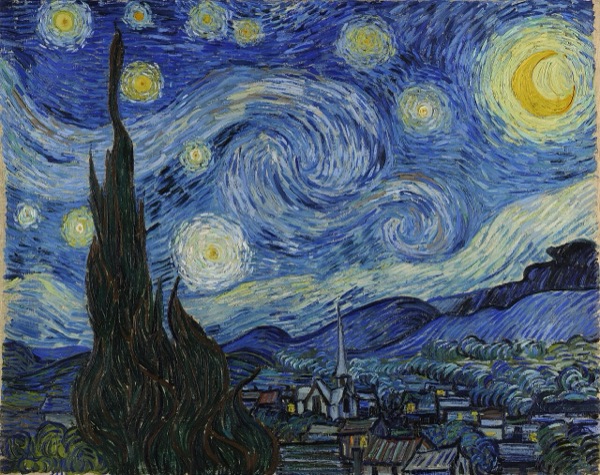
The Starry Night is the view before sunrise, but it isn't a straight record. The village, with its church spire that looks more Dutch than Provençal, is mostly invented or moved. The cypress in the foreground is brought close and made enormous. He painted it in the studio during the day, from memory and imagination as well as observation.
He wasn't sure it worked. In a letter to his friend, the painter Émile Bernard, he called it a failure. It's now one of the most reproduced paintings in the world.
What to look at
- The brushstrokes. Up close, the sky is built from short, thick, directional strokes laid side by side, like a woven surface. Nothing is blended.
- The cypress. Dark, flame-shaped and rising past the horizon, it links the ground to the sky. Cypresses were associated with cemeteries and mourning, and Van Gogh was fascinated by them.
- The quiet village. Below the turbulence, the houses are small, still, lit from inside. The contrast between the calm town and the moving sky is the painting.
- The bright star. Just right of the cypress is the brightest point in the sky.
What's still debated
The bright 'star' is often identified as Venus, which was visible in the morning sky at Saint-Rémy that spring; that is widely repeated but not something Van Gogh confirmed. The swirls are sometimes said to show turbulence in the air with scientific accuracy, or to reveal his illness directly. Both are interpretations, not established facts.
Where to see it
The Starry Night is at the Museum of Modern Art (MoMA) in New York, which acquired it in 1941. It's one of the museum's most visited works, so expect a crowd in front of it. Check MoMA's website for its current gallery, hours and tickets.
See it in person? Scan it.
Point your iPhone at The Starry Night, or any painting in the room. DeFrame names the work and its artist, then shows you how to really look at it. Free, no account needed.

Questions people ask
What does The Starry Night show?
The view from Van Gogh's room at the asylum in Saint-Rémy-de-Provence before sunrise, with an invented village and an enlarged cypress tree. It combines observation with memory and imagination.
Where is The Starry Night?
It is at the Museum of Modern Art (MoMA) in New York, which acquired it in 1941. It is not in the Van Gogh Museum in Amsterdam.
When did Van Gogh paint The Starry Night?
In June 1889, during his stay at the asylum in Saint-Rémy-de-Provence.