
The story
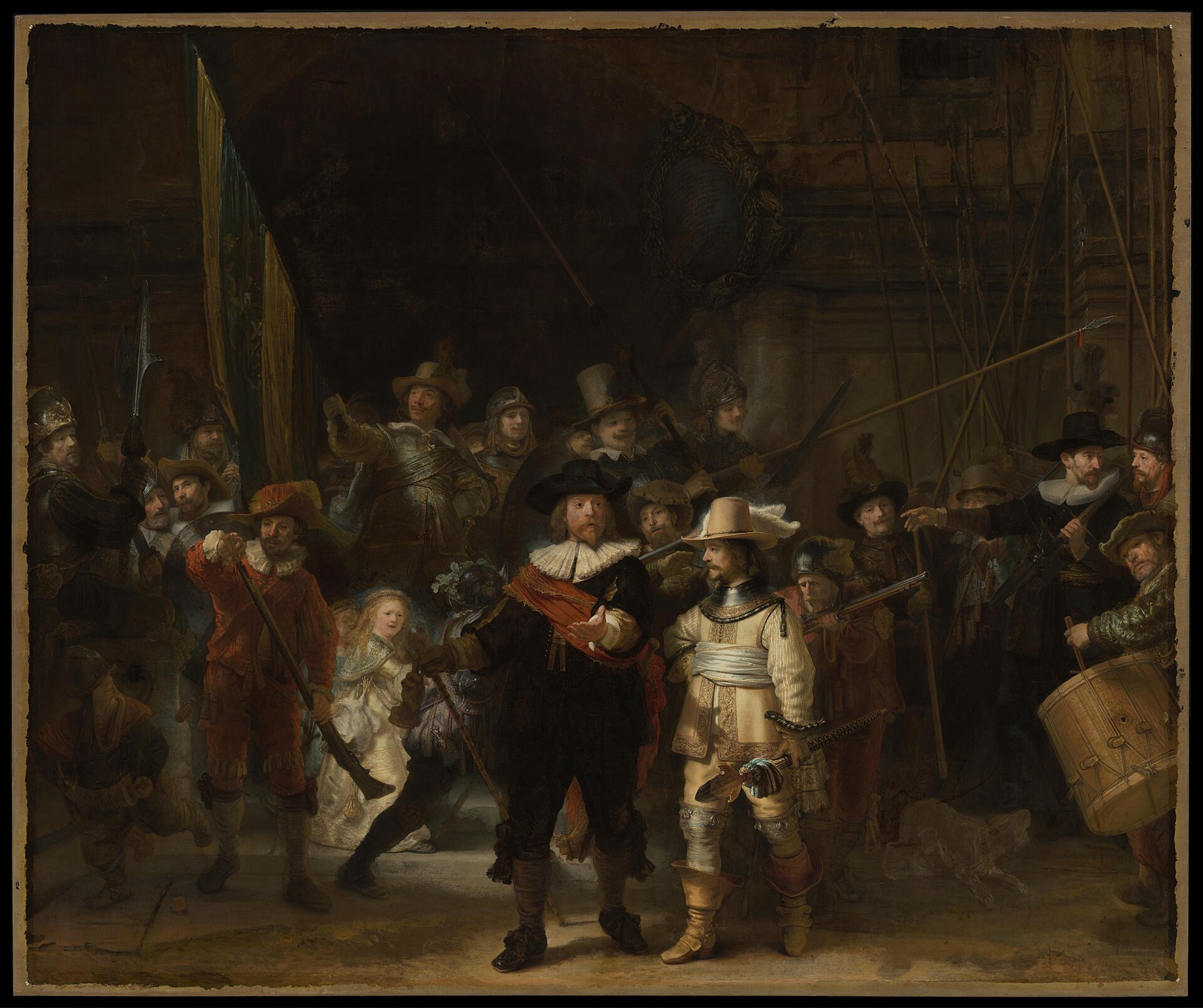
Its real title is long: Militia Company of District II under the Command of Captain Frans Banninck Cocq. The company's members paid to be included, and they expected what group portraits usually gave them: everyone lined up, everyone equally visible. Rembrandt gave them movement instead. The captain is mid-stride, giving an order. A drum sounds, a dog barks, a musket goes off. Some of the men who paid are half hidden in shadow.
And it isn't night. The name came much later, in the 18th century, when layers of darkened varnish and dirt had made the scene look nocturnal. Under that, it's daylight.
In 1715 the painting was moved to Amsterdam's town hall and trimmed on all four sides to fit between two doors. Strips were lost, most of all on the left, where several figures disappeared. We know what was there from a smaller copy made before the cut.
What to look at
- The captain's hand. Banninck Cocq's outstretched left hand throws a shadow onto his lieutenant's gold coat. It's the detail that makes the scene feel three-dimensional.
- The girl in gold. A small, glowing girl among the soldiers carries a dead chicken at her waist. Its claws were a symbol of the militia, the Kloveniers. She is the company's emblem, made into a person.
- The light. Rembrandt lights only a few figures and lets the rest fall into shadow. Follow where the light lands and you see whom he chose to make the story about.
- The size. It's nearly four metres tall. Stand back first to take in the whole crowd, then move close to see the brushwork.
What's still debated
A popular story says the painting was a disaster that ruined Rembrandt's career because the paying sitters were angry. Historians largely reject this: there is no evidence the company rejected it, and his later money troubles had other causes. The painting has also been attacked several times, in 1911, 1975 and 1990, and restored each time. A large research and restoration project, Operation Night Watch, began in 2019 in public view in the museum.
Where to see it
The Night Watch hangs at the end of the Gallery of Honour in the Rijksmuseum in Amsterdam, in a room built around it. It is the museum's most visited work, so going early or late in the day helps. Check the Rijksmuseum website for hours and tickets.
See it in person? Scan it.
Point your iPhone at The Night Watch, or any painting in the room. DeFrame names the work and its artist, then shows you how to really look at it. Free, no account needed.

Questions people ask
Why is it called The Night Watch?
The name was given in the 18th century, when darkened varnish and dirt made the scene look like night. It actually shows the militia company in daylight. Its official title names the company and its captain, Frans Banninck Cocq.
Where is The Night Watch?
It is in the Rijksmuseum in Amsterdam, at the end of the Gallery of Honour.
Was The Night Watch cut?
Yes. In 1715 it was trimmed on all four sides to fit a wall in Amsterdam's town hall. The largest loss is on the left side, where several figures were cut away.