
One-liner
The American painter who made the act of painting as radical as the result.
He didn’t stand in front of a canvas. He stood inside it.
Pollock took the canvas off the wall, laid it on the floor, and spent his poured-paint years turning gravity, rhythm, and raw physical energy into something that still looks like nothing else.

The American painter who made the act of painting as radical as the result.
Jackson Pollock became the defining figure of Abstract Expressionism by taking the canvas off the easel, laying it on the floor, and building a new kind of painting from poured enamel, full-body movement, and total concentration. His breakthrough lasted roughly from 1947 to 1951. He was 44 when he died.
Pollock absorbed Benton’s compositional energy, Siqueiros’s experimental enamel techniques, Surrealist automatism, and the scale of the American West. He pushed all of it toward something without a clear precedent. Harold Rosenberg named it: ‘the canvas is an arena in which to act.’ Helen Frankenthaler’s stain technique grew directly from Pollock’s unprimed-canvas pours. Allan Kaprow’s Happenings built on the ‘arena’ idea. Process art, performance art, and a generation of painters who followed all trace something back to what Pollock did in that barn.
Three quick beats that help you feel the story.
Paul Jackson Pollock — he dropped the Paul at eighteen — grew up across the American West, youngest of five brothers in a family that never stopped moving. He took surveying trips with his father through Navajo, Hopi, and Zuni lands, and arrived in New York in 1930 to study under Thomas Hart Benton. He was searching for a visual language that fit the scale of what he’d grown up seeing. He was also an alcoholic by fifteen.
In the winter of 1946–47, working in the converted barn at Springs on Long Island, Pollock put the canvas on the floor and started pouring. He moved around it from all four sides — crouching, stepping over it, leaning in — directing streams of commercial enamel with sticks, hardened brushes, and basting syringes. From 1947 to 1951 he produced the drip paintings. A body of work that made action itself the subject.
Pollock shifted painting’s center from Paris to New York and changed what the medium could mean: not a window or an illusion, but the residue of a physical event. He didn’t outlive his breakthrough by much — dead at 44, driving drunk less than a mile from home — but what those four or five years produced remains among the most studied, most copied, and most argued-about work in modern art.
Pieces mentioned in the story, with a closer look.
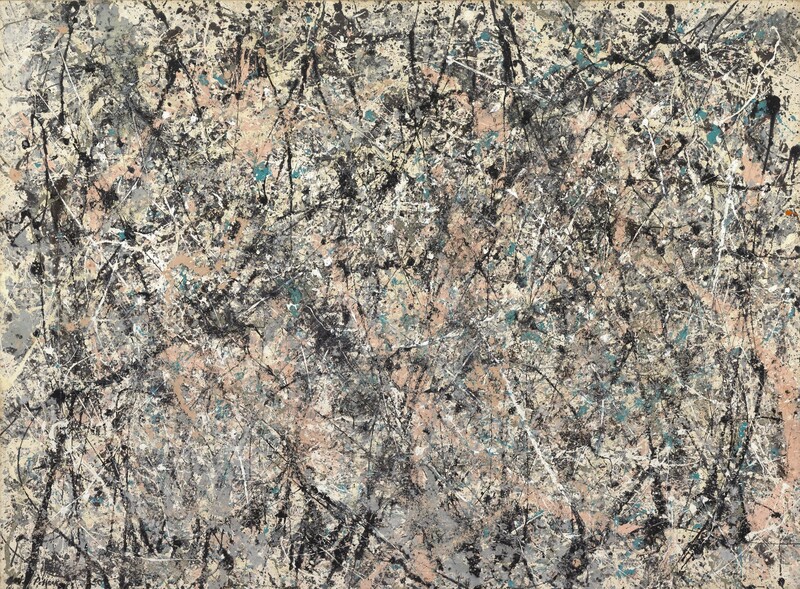
Try this: stand far back until the whole surface reads as a single field, then move close and follow one thread of paint as far as it goes before it disappears under another layer.